

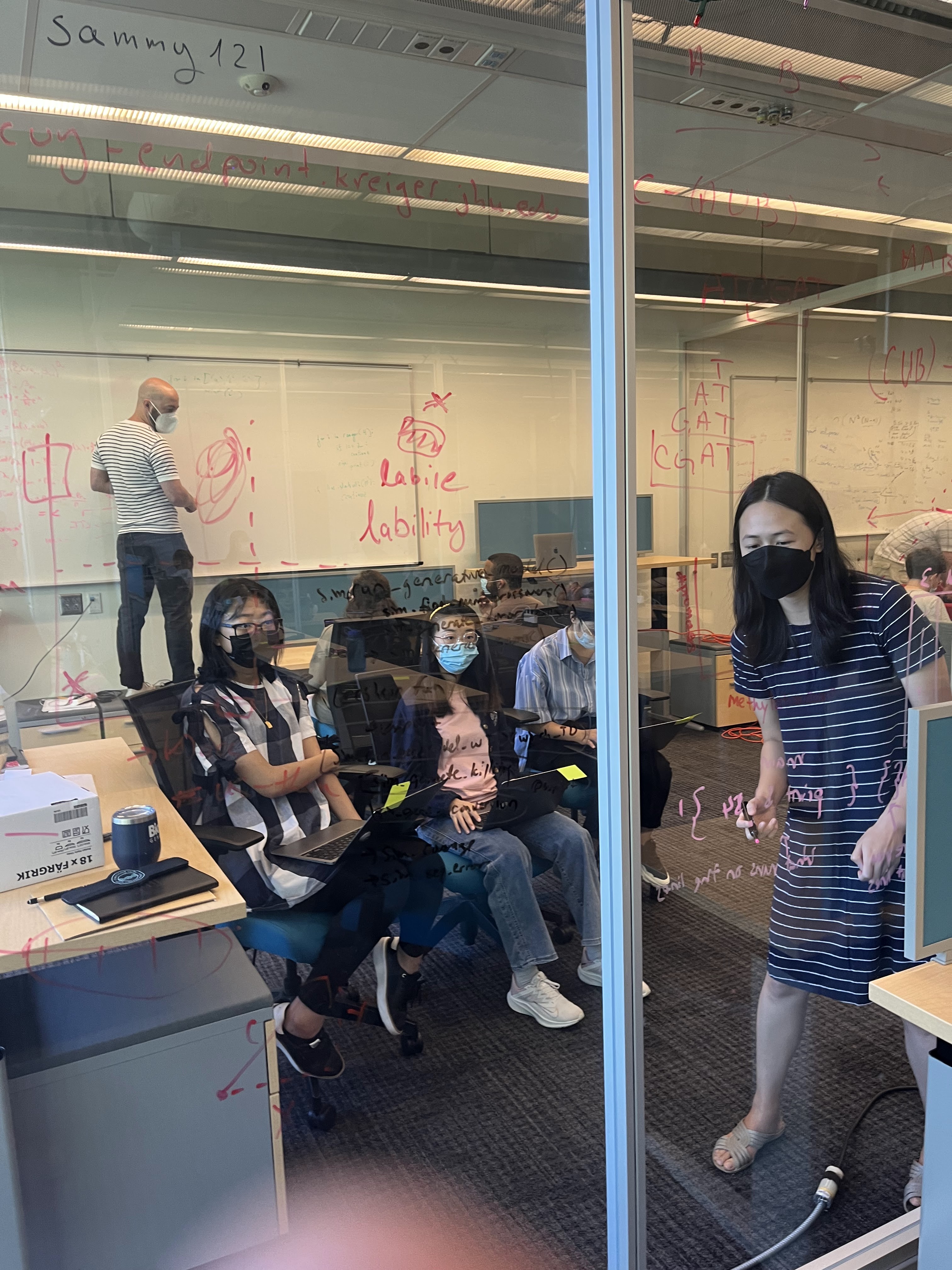
Graduate teaching: During the fall, I teach the Quantitative Biology Bootcamp (co-instructors: Frederick Tan and Michael Sauria) and Lab (co-instructor: Michael Sauria) to first-year students in the CMDB graduate program. Quantitative and computational methods are increasingly essential to all sub-disciplines of modern biological research. The goal of the week-long “bootcamp” is to empower students with the fundamental skills to apply these methods, as well as connect them to resources for further developing their knowledge and abilities. This is achieved using active learning exercises, where for most of the class, students perform data analysis to address biological questions and reinforce core bioinformatic concepts. The subsequent lab course builds upon the foundations of the bootcamp, reinforcing and expanding upon mathematical and computational methods for analysis of biological data. Topics are integrated with the curricula for concurrent core courses in molecular biology and cell biology.
Undergraduate teaching: During the spring, I teach Human Genome Variation (co-instructor: Kyle Cunningham) and Computational Lab to upper-level undergraduate students. These courses courses seek to expose students to the extraordinary pace and creative, dynamic process of research in the field of human genetics, which has experienced a recent revolution driven by sequencing technologies and computational advances. The lecture portion of the course covers topics in personalized medicine, evolutionary genetics and ancient DNA, as well as social and ethical implications of human genetic research. In addition to lectures, students present and discuss primary literature with guidance and feedback from the instructors. I am the sole instructor for the computational lab course, which gives students with a wide range of computational experience exposure to actual genetic data analysis. Using a cloud-based computing platform, we explore public datasets and bioinformatic tools used to analyze human genomic data to better understand how patterns in these data can be used to test hypotheses about evolution and human phenotypes.
Materials for this course were recently enhanced with the support of a Technology Fellowship from the Johns Hopkins Center for Teaching Excellence and Innovation (graduate student recipients: Stephanie Yan and Kathryn Weaver), allowing us to develop an online textbook and cloud-based modules to facilitate student learning: https://mccoy-lab.github.io/hgv_modules
 McCoy Lab